
SEEKING SUPERVISION?
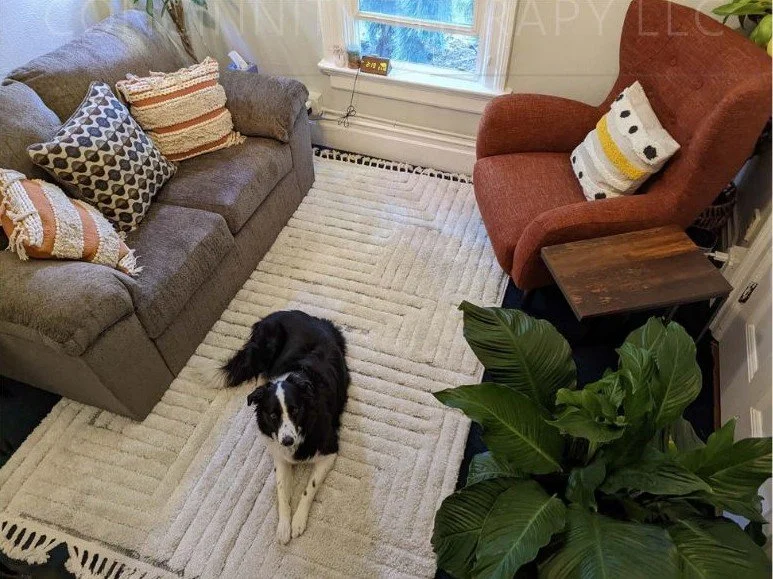
(sans the pup - Riley is just here for the vibes😊)
Background in Service, Teaching and Supervision
I have been serving individuals, couples and families and helping them navigate relationships for over 19 years as a counselor at law, attorney counselor, and now, as licensed marriage and family therapist as well as licensed professional counselor in private practice. I have taught as an adjunct faculty member at Lewis and Clark and Antioch University. I am an AAMFT clinical fellow and AAMFT Approved Supervisor. I currently offer supervision to new trainees or associates in Oregon.
Philosophy and Approach to Supervision
I believe the purpose of supervision is to socialize supervisees into the counseling and psychotherapy practice within a growth-fostering relationship. I see the overarching goals of supervision as providing relational support and guidance to new therapist trainees or associates; facilitating the development of knowledge or skillsets; and offering a counterbalance (e.g., gatekeeping functions) to potential harm to clients or the field. I recognize the manner society constructs knowledge (often in beneficial ways to certain social groups), the importance of frameworks that deconstruct dominant discourses through critical examination of power or meaning-making, and the significance of challenging the notion of a single truth. To this end, I adopt principles of relational cultural theory (RCT; Miller, 1976), and multicultural orientation (MCO; Owen, 2013; Owen et al., 2011) as my theoretical lens. RCT recognizes the importance of growth-fostering relationships to human development and that privilege, power and oppression shape our relational images and capacity for mutual empathy. MCO is a cultural framework that involves the practice of cultural humility, cultural opportunities (e.g., being attuned to ethnoracial or cultural differences) and cultural comfort (e.g., embracing discomfort from differences). MCO takes into account an intersectional lens; the ways in which racism, settler colonialism, and other systems of oppression shape lived experiences and worldviews.
In operationalizing my theoretical lens, I use the therapeutic pyramid, which is a common factors meta-model for supervision (Davis et al., 2020). The pyramid consists of three layers: At the base is my supervisor’s way of being/personhood, which for me is premised on MCO’s cultural humility and relational cultural theory consistent with Martin Buber’s (1970) concept of the I-Thou relationship (seeing another as a whole being, not an object); at the middle is the supervisory relationship where we attend to our alliance in a power-conscious way using an intersectional lens, and attending to or embracing cultural issues or differences; and at the top is our focus on skills and techniques, which are heavily influenced by my knowledge, education, and training as an integrative therapist. This includes emotionally focused therapy, attachment theory, EMDR, somatics and neurobiology, amongst others.
If you have questions or are interested in becoming a supervisee, please reach out to me at counseling@concinnitytherapy.com.